“Chivalry Is Dead”: Woman Goes to Hilarious Extremes to Try and Get a Seat on Crowded Train
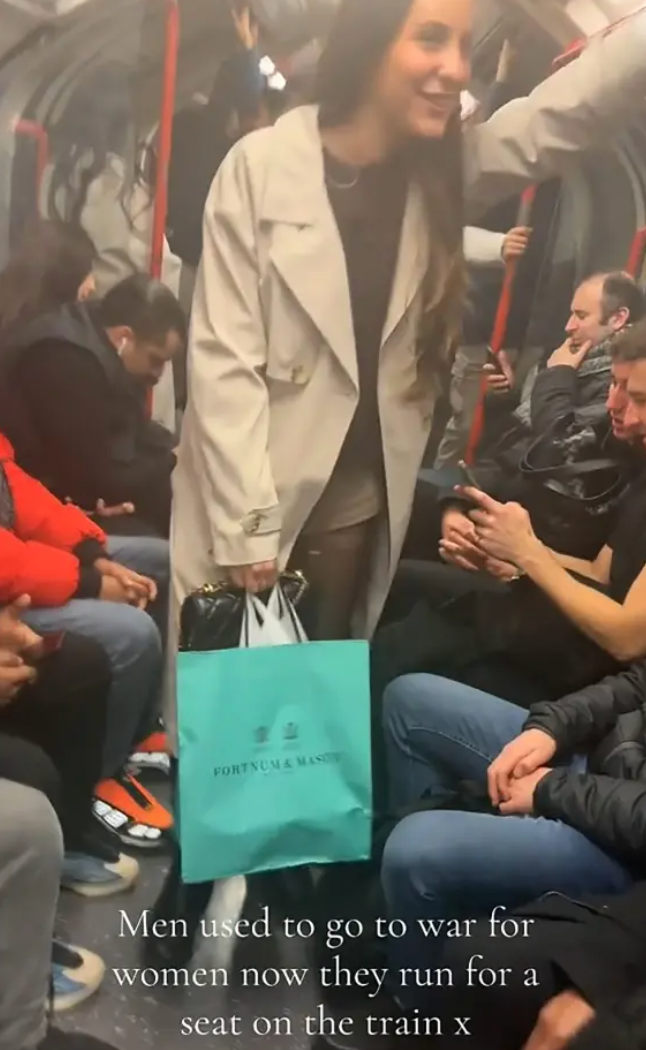
A short video filmed on a crowded train has reignited a long-running debate about chivalry, feminism, and modern social expectations — and the internet has plenty to say about it.
In the clip, a woman can be heard dramatically groaning while standing among seated male passengers. “Owww, my legs hurt so much… I wish I could sit down… owww,” she says, exaggerating her discomfort as the men around her briefly glance up, smirk, and then return to their phones without offering a seat.

“Men used to go to war for women; now they run for a seat on the train.”
Within hours, the video sparked a flood of reactions.
Many commenters were quick to declare that traditional manners are gone for good. “Chivalry is dead,” one wrote, while another joked, “Don’t disturb them — they’re busy wondering why they’re lonely.” Others mocked the seated passengers, calling them “princesses resting their weary legs.”
Some men weighed in too, arguing that offering a seat is basic courtesy. “Giving up a seat is a gentlemanly gesture,” one comment read. “Manners maketh the man.” Another added that those who stand up understand that “children and women come first.”
But not everyone agreed.
The feminist pushback
A significant number of viewers pushed back hard against the idea that men should automatically give up their seats for women.
“Do you want equality or not?” one commenter asked bluntly. Another added, “Why should anyone give up a seat just because she’s a woman?”
Several pointed out that the woman appeared young, healthy, and physically capable of standing, questioning why a stranger should be expected to sacrifice a peak-hour seat in that situation.
Others argued that years of emphasizing independence and equality have fundamentally changed social dynamics — and that frustration over lost “chivalry” ignores those changes. “You fought for this,” one user wrote. “This is what equality looks like.”
What the research shows
Data appears to support a more nuanced view. A 2023 transport behavior study on seat-yielding found that commuters are far more likely to offer seats when vulnerability is obvious — such as to elderly passengers, pregnant women, or people with visible disabilities.
When someone appears young and healthy, however, passengers are significantly less likely to give up their seat. Most respondents described seat-giving as a need-based, gender-neutral courtesy, rather than something owed based on sex.
Why the video struck a nerve
The idea of chivalry dates back to the 12th century, when it guided medieval knights through values like honor, courage, and protection of the vulnerable. Over time, the term evolved to include everyday gestures such as holding doors open or offering seats to women.
Modern feminism has challenged these traditions, arguing that women are not fragile and should not receive special treatment solely because of gender.
Comedian Dave Chappelle famously summed up the tension with his provocative line:
“Chivalry is dead, and women killed it.”
An expert perspective
Etiquette expert Kate Heussler says the issue isn’t that chivalry has disappeared — but that it’s often misunderstood.
“Offering a seat on public transport should never be about gender alone,” Heussler explains. “Good etiquette is about awareness, respect, and reading the room.”

According to Heussler, modern courtesy is situational. If someone looks unsteady, elderly, injured, heavily pregnant, or clearly struggling, offering help is appropriate — regardless of whether the person is male or female.
Problems arise, she says, when old-fashioned chivalry removes personal agency. “Most women don’t want to be rescued simply because they’re women,” she notes. “They want to be treated with consideration and dignity — the same way anyone else would.”
In 2025, Heussler argues, etiquette isn’t about grand gestures or proving a point.
“It’s about being observant, offering help without assumption, and being gracious whether that offer is accepted or declined,” she says. “Courtesy has evolved — and that’s not a bad thing.”
As the viral video shows, the debate over chivalry isn’t really about seats on a train. It’s about how society balances kindness, equality, and expectation in shared public spaces — and that conversation is far from over.